


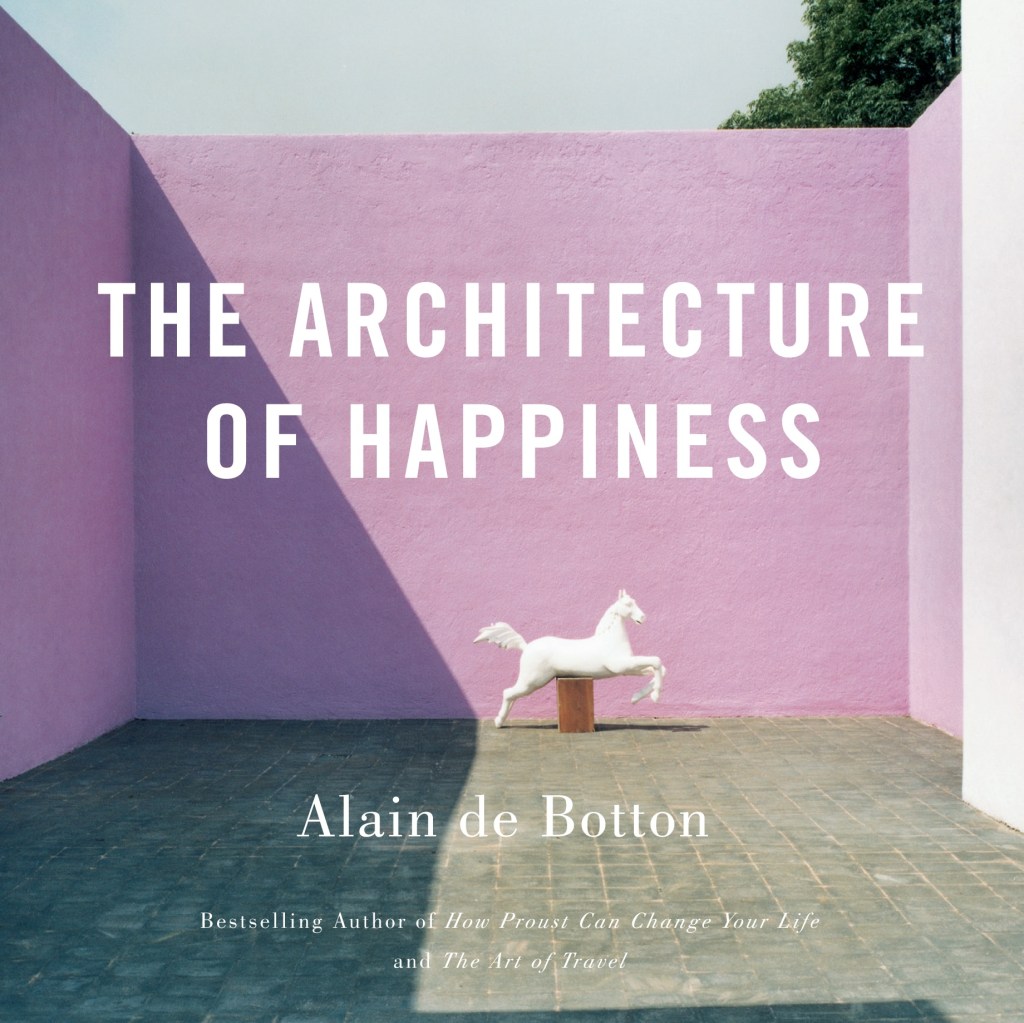
“Manifesto” may sound too forceful for Alain de Botton’s quietly poetic writing, but it feels right to me to call The Architecture of Happiness exactly that: a manifesto in defense of the emotional and moral importance of architecture. De Botton argues that the buildings we inhabit are not neutral containers for our lives—they actively shape how those lives unfold. His premise seems simple: that good design matters because it influences our moods, our habits, and even our capacity for kindness. But as he unpacks this idea, it becomes something profound.
What I love about this book is that de Botton writes as a philosopher, not an architect. That distance lets him examine the built environment without the pressure of defending a particular style or theory. He’s less interested in which materials or layouts are “right” than in how architecture can mirror who we are (or who we wish to become). “It is architecture’s task,” he writes, “to render vivid to us who we might ideally be.” I underlined that line the moment I read it.
De Botton’s prose gives weight to feelings we all instinctively understand. When someone rearranges their bedroom, chooses a paint color, or lingers over the way light falls through a window, they’re doing something deeply human: curating a space that reflects and supports their inner life. The Architecture of Happiness shows that this impulse is not vanity; it’s a kind of care.
Reading this book made me reflect on how we can design not just for beauty or efficiency, but for well-being. It’s an idea that resonates with everything I’ve been exploring lately. De Botton puts language to what I’ve long felt: that architecture, at its best, is a form of empathy.
In a world where speed and convenience often dictate design, this book is a reminder to slow down and ask how our surroundings make us feel. It’s both a love letter to architecture and a gentle challenge to anyone who thinks aesthetics are secondary to function. I’m grateful to de Botton for articulating what I hope will remain at the heart of my own creative path as I work to create beautiful, intentional spaces that don’t just house us but also help us live better lives.
 Allegra on Art & Architecture